
Table of Contents
- Introduction
- Infanta Sofia’s Position Within the Spanish Royal Family
- Her First Independent Royal Engagements
- Infanta Sofia’s First Official Speech
- Her Role in Supporting the Spanish Crown
- What Her Future Royal Duties Could Look Like
- Frequently Asked Questions
- Conclusion
INTRODUCTION
Infanta Sofia’s royal duties are becoming increasingly important as the younger daughter of King Felipe VI and Queen Letizia gradually takes on a more visible position within the Spanish Royal Family. Born on April 29, 2007, Sofia is the younger sister of Princess Leonor, the heir to the Spanish throne. Because Leonor holds the position of Princess of Asturias, Sofia’s constitutional role is different from that of her older sister.
For much of her childhood, Sofia’s public appearances were mainly made alongside her parents and sister. However, that pattern has started to change. In recent years, she has begun participating in independent engagements connected with culture, social causes, education, and national institutions. In 2026, this development reached a significant milestone when Sofia delivered her first official speech. (¡HOLA!)
Her expanding public presence does not mean that she has the same responsibilities as the heir. Instead, Sofia is developing a separate role that can allow her to support the Crown while continuing her education and building her own interests.
Infanta Sofia’s Position Within the Spanish Royal Family
Infanta Sofia is the second daughter of King Felipe VI and Queen Letizia and currently occupies the second position in the line of succession to the Spanish throne, behind Princess Leonor. The official Royal Household lists Sofia as a member of the Royal Family alongside the King, Queen, and Princess of Asturias.
Her position explains why her royal duties are different from those of Leonor. Princess Leonor is the heir and is being prepared specifically for her future role as Queen of Spain. Her education has included extensive military training because of the constitutional relationship between the Crown and Spain’s Armed Forces.
Sofia does not have the same requirement. Instead, she has pursued an international academic path, including her studies at UWC Atlantic College in Wales and university education in political science and international relations.
This gives her greater flexibility while still allowing her to participate in the public work of the monarchy.
Her duties can include:
- Attending official ceremonies
- Representing the Royal Family at selected events
- Supporting cultural initiatives
- Participating in charitable and social activities
- Meeting members of the public
- Presiding over institutional events
- Giving speeches
- Supporting programs connected with education and young people
Her role is therefore best understood as a supporting public role within the royal family, rather than a constitutional role equivalent to that of the heir.
Her First Independent Royal Engagements
The development of Infanta Sofia’s royal duties became particularly noticeable when she began undertaking engagements without King Felipe VI, Queen Letizia, or Princess Leonor.
One important milestone came with the National Heritage Photography Awards, an event connected with a photography competition bearing Sofia’s name. Her interest in photography made the engagement particularly appropriate.
She later undertook another solo appearance at an ONCE Foundation guide dog breeding and training centre near Madrid. The visit focused on the work of preparing guide dogs to assist people who are blind or visually impaired. This was reported as her second solo engagement. The ONCE visit also demonstrated a different side of Sofia’s public role. Rather than attending only a ceremonial occasion, she was able to learn about an organisation working directly with people and animals.
During the visit, Sofia met staff members and saw the training work taking place at the centre. The occasion allowed her to engage with a social cause in a more personal setting. These early solo appearances are important because they show that Sofia is gradually learning how to represent the Royal Family independently. Her public responsibilities are developing step by step rather than appearing all at once.
Infanta Sofia’s First Official Speech
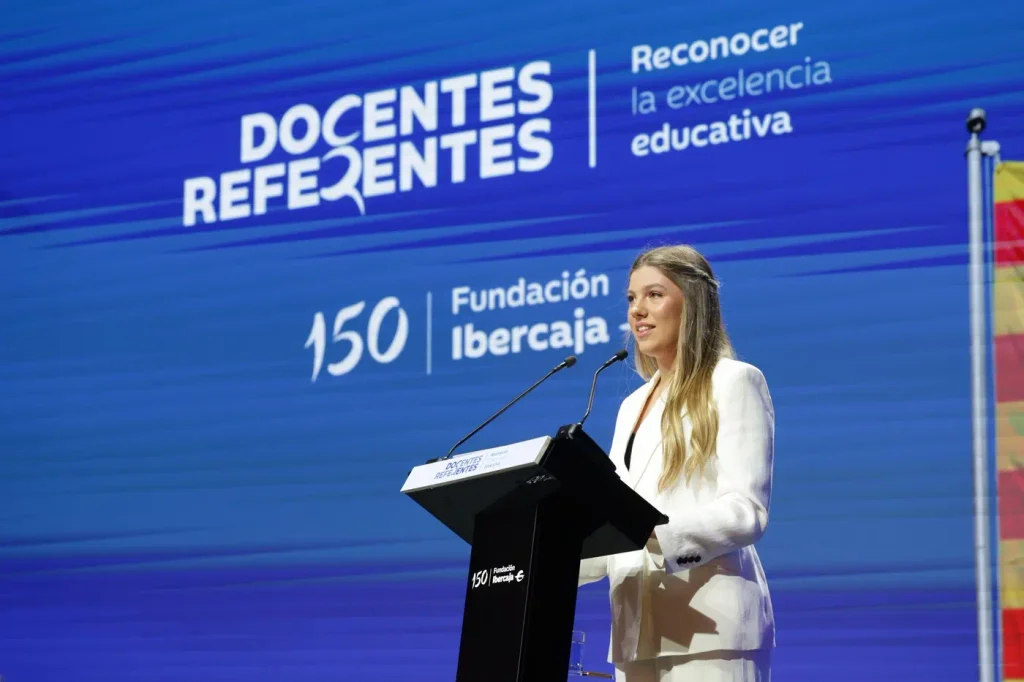
One of the biggest milestones in Infanta Sofia’s royal duties in 2026 was her first official speech. On July 8, 2026, Sofia delivered an address in Zaragoza at an event connected with the Ibercaja Foundation’s Docentes Referentes programme. It marked her third solo public engagement and represented a major step forward in her public role. The occasion was particularly significant because giving a speech requires a different level of responsibility from simply attending an event. A royal representative giving an official address must:
- Prepare appropriate remarks
- Understand the purpose of the event
- Address guests formally
- Represent the institution
- Communicate clearly
- Demonstrate confidence in public
For Sofia, this was an important opportunity to develop those skills. Her first speech also had symbolic significance because Princess Leonor had already reached this stage several years earlier. Leonor delivered her first major public speech at the Princess of Asturias Awards in 2019. Sofia’s first official address, therefore, represented another step toward establishing her own identity within the Royal Family.
Her honorary presidency
Sofia’s 2026 responsibilities also include an honorary presidency connected with the Docentes Referentes programme. According to reporting, she became honorary president of the initiative in February 2026. Her role includes supporting a programme focused on recognising outstanding teachers and their contribution to education. Education is a particularly appropriate area for Sofia because of her own international academic background. She has studied in Spain, Wales, and Portugal and is continuing her university education in Europe. Her personal experience as a student gives her an additional connection with educational initiatives.
Her Role in Supporting the Spanish Crown
Infanta Sofia’s public role can become increasingly useful to the Spanish monarchy as Princess Leonor takes on more responsibilities. Leonor’s position as heir means that her schedule will become increasingly demanding as she prepares for her future constitutional role. Sofia can support the institution through selected events and causes without carrying the same constitutional burden. This does not mean that Sofia will automatically receive a large number of official duties. The Spanish Royal Household has a relatively limited working royal structure, and the responsibilities of each member are carefully defined. Instead, Sofia’s public profile is likely to develop around areas that match her interests and education.
Culture and photography
Photography is one clear example. Her connection with the National Heritage Photography Awards allows her to support culture while engaging with an area she personally enjoys. This creates a natural relationship between her interests and her public responsibilities.
Education
Education is another potential area. Her honorary presidency of the Docentes Referentes programme demonstrates that educational initiatives can become part of her public work. Her international education also gives her a useful perspective on young people and educational opportunities.
Social causes
The ONCE guide dog centre visit showed another possible direction for her role. Such engagements allow Sofia to learn about organisations serving people with disabilities and to draw public attention to their work. These activities can give royal duties a practical social dimension rather than making them purely ceremonial.
What Her Future Royal Duties Could Look Like
The future of Infanta Sofia’s royal duties remains flexible. Unlike Princess Leonor, she is not expected to become monarch under the current succession arrangement. This gives her an opportunity to develop a different combination of education, personal interests, and public service. Her university degree in political science and international relations could also be relevant to future responsibilities.
She is gaining knowledge about:
- Politics
- International relations
- European affairs
- Government
- Society
- Political institutions
- Global issues
That academic background could eventually support public engagements involving international organisations, European institutions, education, culture, or young people. Her international lifestyle may also be valuable. Sofia has studied at an international boarding school in Wales and a university in Portugal, with Paris becoming her next academic destination. Living and studying in different European countries can help her develop a broader understanding of European society.
A role alongside Princess Leonor
Sofia’s future should also be considered in relation to Leonor. Leonor is being prepared to become queen. Sofia can potentially serve as a supporting member of the royal family while maintaining her own professional and academic identity. Their roles do not need to be identical. Instead, their differences can strengthen the institution. Leonor’s work will naturally focus on constitutional preparation, national representation, and her future position as head of state. Sofia can focus on selected cultural, educational, social, and international activities. Her recent engagements suggest that this gradual approach is already beginning.
Frequently Asked Questions
1. What royal duties does Infanta Sofia have?
Sofia is gradually taking on independent public engagements. Her recent duties have included supporting photography and cultural initiatives, visiting an ONCE guide-dog training centre, and serving as honorary president of the Docentes Referentes education programme.
2. Has Infanta Sofia given an official speech?
Yes. Sofia delivered her first official speech on July 8, 2026, at an event connected with the Ibercaja Foundation’s Docentes Referentes programme in Zaragoza.
3. Is Infanta Sofia being prepared to become Queen of Spain?
No. Princess Leonor is the heir to the Spanish throne and is being prepared for the future role of queen. Sofia is second in line under the current succession arrangement and is developing a different public and educational profile.
Conclusion
Infanta Sofia’s royal duties are gradually becoming an established part of her life as a member of the Spanish royal family. While she does not have the constitutional responsibilities of her older sister, Princess Leonor, her public role is becoming more independent and meaningful.
Her early solo engagements demonstrated that she can represent the Crown without relying on her parents or sister. Her visit to the ONCE guide-dog centre showed her involvement with a social cause, while her connection with the National Heritage Photography Awards reflected her personal interest in photography.
The most important milestone came in July 2026, when Sofia delivered her first official speech at the Docentes Referentes event. Her honorary presidency of the education initiative also indicates that education and young people could become important areas of her public work. As Sofia continues her university education and gains more international experience, her role is likely to develop gradually. She does not need to follow exactly the same path as Princess Leonor.
Instead, Sofia is building her own place within the monarchy through education, cultural interests, social causes, and carefully selected public engagements. Her growing independence suggests that Infanta Sofia will likely become an increasingly visible supporting member of the Spanish royal family while Princess Leonor continues her preparation for the throne. Together, the sisters represent two different but complementary paths for the future generation of the Spanish Crown.